
Alternative Realities For 2025's College Football Postseason

One week ago tonight, after the latest college football national championship game playoff in history, the curtain finally fell on a college football season AND postseason unlike any other. It's difficult for me to think of the last time the prognosticators were so wildly off-base for what was in store: 13 of the preseason Top 20 missed out on the playoff, including #'s 1 and 2; multiple teams in that Top 10 missed out on bowls altogether, and several teams in that Top 15 fired their head coaches. I will give the forecasters credit for one thing, though: they placed Miami at # 10 preseason, and that is exactly where the Hurricanes ended up, sneaking the last at-large playoff bid from a crowded pool of candidates, and riding that high to an unlikely berth in the National Championship game, played in their home stadium. The only thing keeping them from the happy ending to their fairytale was an even bigger fairytale story, one of the biggest we've ever seen in this sport: Curt Cignetti and the Indiana Hoosiers. It's hard to put into words just how unlikely this Hoosiers natty run would have seemed just two years ago-- hell, after suffering the "fraud" allegations after their playoff loss last year and opening this year at # 20, it didn't even seem particularly likely this season. But Cignetti completed one of the most rapid and most stunning program turnarounds in college football history, taking an infamously dormant Indiana football program from one of the worst teams in the country in 2023 to a perfect 12-0 season this year. Then a 12-0 team beating reigning national champions Ohio State in the Big Ten championship. Then a 13-0 Big Ten champion team boasting the school's first-ever Heisman winner at QB. Then a # 1 team becoming the first (and still only) team in the two years of the 12-team playoff to win as one of the seeded "first round bye" teams. Then a 15-0 team who had just beaten the brakes off of Alabama and Oregon in consecutive games so comprehensively they began to endure cheating allegations...to national champions. What a story.
This was the second year of the expanded playoff model, moving from 4 teams to an unprecedented 12 after the 2023 season. Pretty much since the announcement that the 4-team playoff field, consisting solely of four teams a committee deemed "the best four," would triple in size, and feature 5 automatic bids for conference champions (including, in its inaugural year, first-round byes for the Top 4 among them), there was criticism. Criticism of the format, for one, whether it had to do with the existence of byes, or the fact that the quarterfinals were played at bowl sites and not home campuses. But more prominently, criticism from the sport's purists that this number was far too large, cries that only got louder as the lower-seeded teams all got blown out in the first round last year.
Yet I, for one, was happy for the field extension even before a much more competitive and entertaining postseason quieted some of those voices this year. And in fact, I loudly and proudly stand in the minority of college football fans would welcome further expansion. My chief reason for this that I simply don't subscribe to the theory that a regular season is sufficient enough as 'play-in rounds,' and that a playoff was going to give us the same couple champions every year anyway. For starters, for every season in which we have a "clear top 2 teams," there's ones like this one, the first year of the expanded playoff in 2024, and even the very first year of the 4-team playoff, wherein the undisputed Top 2 teams lost their first game and there were at least a couple teams left out of the playoff altogether that had a very legitimate case to be included. Furthermore, who's to say that the playoff would give us the same teams every year? That's the beauty of March Madness, isn't it? The reason it's so hard for teams to even play, let alone win, titles in college basketball as effortlessly as Alabama did for a while in college football is because it's really freaking hard to string together 6 performances against the nation's best teams over the course of 3 weekends every year. If a selection committee handpicked the Final Four in basketball the way they do in football, we'd see Kentucky and Duke trading off titles every season. Instead, despite those programs being consistently among the highest seeds in the tournament, they've won 3 championships amongst themselves in the last 20 years. A wider field means just that, a wider chance for everyone, and thus, less of a guarantee that we'd be seeing the same teams atop the podium year after year.
All this being said, I thought it'd be fun to once again examine how some of the different playoff ideas would have transpired this year. Specifically, I thought we'd look at the old model we had, but some alternate ideas as well, such as a massive 32-Team model, as well as two formats that borrow from the world of soccer, a 'Champions League' and a 'Super League' model. In terms of how these alternate realities played out: I generally would simulate the showdowns (using accurate home-field and weather conditions) via whatifsports.com, although when relevant, I just went on bowl results and/or real-life head-to-head showdowns. It's imperfect, I know, but it's hard to know what else to work with.
ALTERNATE REALITY 1: THE ORIGINAL MODEL
Brief refresher of the format
4 teams
No automatic bids; simply the teams the playoff committee ranked 1-4 in their final rankings of the season
The semifinals would be played at two "New Year's Six Bowl" sites on a rotating basis
Championship would be played at a neutral site, based on highest-bidding stadium
How it all went down
New Year's Six Bowls:
Cotton Bowl: # 8 Oklahoma 26-16 # 19 Tulane
Orange Bowl: # 7 Texas A&M 23-35 Duke
Rose Bowl: # 5 Oregon 37-31 # 9 Notre Dame
Sugar Bowl: # 6 Ole Miss 34-31 # 12 BYU
Semifinals:
Peach Bowl: # 1 Indiana 24-7 # 4 Texas Tech
Fiesta Bowl: # 2 Ohio State 23-3 # 3 Georgia
It's, of course, long a moot point by now, but it has been fun to consider the playoff's original form in the last two years, the 12-team era. The 2024 season was a godsend for the 12-team proponents: everybody other than top-ranked Oregon would have had one argument or another to be included in a 4-team field. This year, however, actually would have set up pretty perfectly under the original 4-team model! An obvious # 1 in Indiana, but a defending champion Ohio State team whose only loss was by 3 to that Indiana team in the Big Ten Championship? Plus two 1-loss major conference champions? That's a pretty straightforward playoff field.
Where chaos would have really ruled under the original model was in the rest of the "New Year's Six." Real-life runners-up Miami wouldn't have even been included in these games, as the ACC's automatic slot went to champions Duke by a convoluted series of tiebreakers; the Blue Devils' wild, unlikely finish to their season continues in this hypothetical scenario with a huge Orange Bowl upset over old coach Mike Elko and Texas A&M. Elsewhere, in this world, conference ties see Notre Dame, BYU and Tulane taking bids from the SEC's 5th-best team, Alabama. Sorry, Greg Sankey and Paul Finebaum, no dice in this world! It goes all chalk in the Cotton, Rose and Sugar Bowls, though not without some thrillers in the latter two specifically.
And as for the playoff itself? Well, everything comes up Big Ten. The Hoosiers thwarting Texas Tech's proficient defense with their Heisman-winning QB in the Peach Bowl isn't particularly surprising, but Ohio State notching an equally-dominant result over SEC champions Georgia in the desert is. The Buckeyes' vaunted defense and offensive weapons like Jeremiah Smith proved to be too much for Kirby Smart and the Dawgs.
CHAMPIONSHIP (Miami):
# 1 Indiana 27-34 # 2 Ohio State
In the playoff we got, Ohio State didn't even come close to the rematch with Indiana they probably were craving in the wake of their narrow Big Ten Championship loss. Under the 4-team format, though, such a scenario would have obviously been much more feasible. And had the Buckeyes gotten another crack at Indiana, the simulation seems to think they would have made the most of it on South Beach. In a much more offense-powered affair than their 13-10 Big Ten title clash, Bo Jackson ran it in from 5 yards out with 37 seconds remaining to give the Buckeyes a hypothetical back-to-back natty.
ALTERNATE REALITY 2: THE 32-TEAM PLAYOFF
Brief refresher of the format
32 teams
All 10 Conference Champions
22 at-large teams
Split into regions, a la March Madness
"Regional Finals", Semifinals and Final all use current format: New Year's Six Bowls for quarters and semis, a rotating neutral site for the championship
How it all went down
1st Round (winning teams are in all caps, conf. champions with asterisk)


The first round goes almost entirely chalk, with the exception of Arizona's road upset over former conference mates USC in overtime. That was far from the only exciting contest, though; in the biggest name-brand matchup of the opening round, Texas outlasts Michigan in a thriller not unlike their real-life Citrus Bowl matchup. The Southeast regional in particular gives us some fun and frisky matchups, as shock ACC champions entered halftime tied on the road with reigning national champs Ohio State, Vanderbilt need a late score from Heisman finalist Diego Pavia to see off underdogs Tulane, and Ole Miss and Miami score wins over conference opponents at home.
Round of 16 and Quarterfinals (winning teams are in all caps, conf. champions with asterisk)


We get triple the amount of upsets in the Sweet 16 that we did in the 1st Round, though: Arizona's Cinderella run continues with a huge road upset of their conference foes, Big 12 champions Texas Tech. Their Cotton Bowl opponents are Oregon, who defeat yet another Big 12 team (runners-up BYU) in a shootout in Eugene. Miami were also road winners, knocking off Ole Miss in a down-to-the-wire thriller, just as they did in the real-life Fiesta Bowl semifinal. Their reward? A virtual home game in the Orange Bowl against Ohio State, who stifle Vanderbilt in snowy Columbus. Notre Dame score an upset too, rallying in Norman to knock off Oklahoma much the way Alabama did in the real-life playoff. That sets up an all-Indiana affair in the Rose Bowl, as in-state rivals (and top overall seed) Indiana cruise past Arch Manning and Texas in Bloomington. And the lone regional to go completely chalk through two rounds, the South sets up an all-SEC affair in the Sugar Bowl, as top seed and SEC champs Georgia cruise at home vs. Utah, and Alabama is denied their crack at the Bulldogs as they fall to A&M in a slugfest in Texas.
A thrilling quarterfinal round sees the end of Arizona's run at long last, though not before giving Oregon a proper scare in the Cotton Bowl. But that doesn't mean it was a round without upsets though, as Miami recreates their real-life upset and knock out the reigning champs, this time in the friendly confines of South Beach. Fittingly the last SEC team left in the tournament are the conference champions, as Georgia rally from 17 down in the 3rd quarter to knock out Texas A&M and banish their New Orleans ghosts that alas, are still very much alive in the real world. Finally, there's no stopping the Hoosier Train in this simulation either, as they get revenge over Notre Dame for last year's playoff loss in the Rose Bowl, albeit not before much more of a battle than real-life Alabama gave Indiana at the same stage.
Semifinals and Final (winning teams are in all caps, conf. champions with asterisk)

The semifinals go pretty much exactly how the real-life ones did: Indiana beats Oregon for the second time this season, albeit in a slightly more competitive game in the desert than the real-life beatdown they put on them in Atlanta. And speaking of Atlanta, despite a virtual home game there, it's Georgia that loses a semifinal thriller to the red-hot Hurricanes rather than their SEC peers Ole Miss in the real playoff. The simulated game actually plays out eerily similar to Miami and Ole Miss's Fiesta Bowl matchup, the two team trading blows in a defensive 1st half, shootout 2nd half, culminating with a short, game-winning TD run for the 'Canes in the final minute.
And so amazingly, despite 20 more teams and 20 more games played, the virtual 32-team playoff gives us the exact same National Championship matchup that the real-life 12-team playoff did: the top-ranked Indiana Hoosiers against the upstart hometown Miami Hurricanes. I see no reason to mess with reality in this identical scenario: Fernando Mendoza's heroic late touchdown run and a last-minute interception takes IU to the summit with a 27-21 win.
ALTERNATE REALITY 3: THE CHAMPIONS LEAGUE PLAYOFF
Brief overview of the format
24 teams
Every conference represented, proportionally
Number of "bids" per conference preset, allocated based partially on conference size but mostly on historical conference performance
8 seeded teams receive first round bye
At least 4 seeds reserved for the 4 highest-ranked conference champions
In the 1st Round through the Quarterfinals, bracket is redrawn so highest-ranked remaining team plays the lowest-ranked, second-highest vs. second-lowest, so on and so forth
Quarterfinals and Semifinals played at New Year's Six bowl sites, Final played at a neutral site based on highest-bidding stadium
How it all went down
Bids and Bracket:

The idea for this model, unveiled last year, came about amidst the maelstrom of playoff field debates down the stretch of the season, and more specifically, how those debates centered respective conference strength. I saw many a take on college football Twitter, some in jest, but many not, about how the SEC and Big Ten should just have a pre-ordained number of teams in the field. That desire became even clearer this season where the SEC bitched and moaned about how their 7th and 8th-best teams deserved a playoff bid more than the teams that ended up qualifying, and this time, ESPN and the playoff committee listened, seeding half the playoff with teams from that conference, controversially including 3-loss SEC title game losers Alabama at the expense of 2-loss conference title game loser BYU and yearlong Top 10 team Notre Dame. (This was a huge loss for the everyday college football fan, but we got our victory in the form of those SEC teams going a whopping 0-4 in the playoff against Power 5 teams from other conferences, with thre crown jewel being that Alabama side getting absolutely pantsed by Indiana in the Rose Bowl.) Well, this soccer-inspired tournament is the format that allows for that. It's a 24-team field, where every conference is represented, but the better performing conferences in recent history automatically seed more teams in the field. It's no secret that the SEC has been the best conference for some time now, hence why they lay claim to 1/4th of the field- but recent positive performances by the Big Ten and ACC in playoff play get them a combined 9 bids, and decent showings by the Big 12 (multiple playoff bids by Oklahoma and Texas, TCU's title run) garner them 3 spots of their own. The beauty of this, too, is that it could change year-to-year; say the Big 12 spawns a national champion, and the other teams perform decently in the playoff? Chances are they earned their conference a bonus spot in next year's playoff. Conversely, if the ACC, for example, had a brutal postseason like they did in real life this year, it might cost them a slot in the following playoff.
Games would be played at the higher-seeded teams' home fields for the first two rounds, before joining up with the current format (quarterfinals and semifinals at "New Year's Six" sites, determined by best geographic match). Seeding would be best on the playoff committee rankings, still, with the one stipulation that the Top 4 of the 8 teams receiving first round byes are the conference champions. Another wrinkle, one that borrows as much from the NFL as it does from European soccer: rather than playing a straight bracket, after both the first round and the Round of 16, teams are re-seeded based on their CFP ranking, so that the highest team remaining is always playing the lowest team remaining, at least until the semifinals.
*One note: the auto-bids would nullify need for conference championship games in the multi-bid leagues, so "champions" and rankings for the Power4 conferences are based on where they were at after Week 15.
1st Round and Round of 16 (winning teams have asterisks)


As most would expect, the four lower Group of 5 champions were mostly dismissed with ease in the first round, although Tulane and James Madison managed to make things interesting for 3 quarters in Los Angeles and Austin, respectively. Only two real games of the note from the first round, but they both took the form of big ACC upsets: Georgia Tech stuns Kyle Whittingham and Utah in Salt Lake City, and Virginia-- who suffered a heartbreaking playoff-eliminating loss in the real-life ACC title game -- find virtual redemption with an upset of Whittingham's new team Michigan in Ann Arbor.
In the Round of 16, when the Top 8 entered the fold, upsets were hard to find, but competitive games in general weren't. Notre Dame gets revenge on one of just two teams to beat them this season, knocking off Texas A&M in a defensive struggle in College Station, Oregon outguns Alabama in a shootout in the Northwest, Miami staves off gritty Oklahoma in an ugly one on South Beach, and in the lone significant upset of the round, BYU stun a Lane Kiffin-less Ole Miss on the Grove with a last-minute TD.
Quarterfinals:

This quarterfinal round provided a lot of juicy matchups, but only a couple actually come to fruition. Both same-conference affairs turn out to be snoozers, as Big 12 champs Texas Tech cruise against runners-up BYU for a 3rd time this season (and 2nd straight at JerryWorld), and Ohio State beat Oregon with surprising ease in the Orange Bowl. It's the top 2 seeds that end up locked in more of a dogfight; Indiana faces a real contest from real-life natty foes Miami, much like they did in that game, but in this world, are still able to get the crucial victory. And lightning strikes twice for SEC champions Georgia, who for the second straight year fall in a Sugar Bowl quarterfinal to Notre Dame behind a 21-0 run in the 2nd half from the Irish.
Semifinals and Final

Not unlike the quarterfinal stage, we're treated to two snoozers followed by a banger. Both semifinals are routine procedures, with Big Ten champs Indiana dominating Big 12 champs Texas Tech in Atlanta, and Ohio State rolling past upstart Notre Dame in the Fiesta Bowl, much as they did in the real-life National Championship last year.
In this virtual natty, however, we're treated to a rematch of the Big Ten Championship just as we were in the 32-team timeline. Whereas that simulation yielded an Ohio State revenge win, this one has Indiana doubling down on their thrilling victory; a 4th quarter that has the two teams combining for 20 points sees the Buckeyes racing to a 4-point lead with 10 minutes left, before a Mendoza-Cooper connection with 6 minutes left retakes the Hoosier lead for good, and cements their national title.
ALTERNATE REALITY 4: THE SUPER LEAGUE PLAYOFFS
Brief overview of the format
6 teams from each conference
4 automatic bids for division winners, 2 at-large teams
Seeding (and at-large bids) based on CFP ranking
Higher seed hosts, 2 highest-seeded division champions in each conference get first-round byes
Conference championships and National Championship played at bowl sites and neutral-site, a la current playoff format
How it all went down
Yes, this is a shameless plug for my own wild proposal for College Football, from just before the 2021 season. I don't know that such a drastic shift is the best idea for the sport, but for a game that's increasingly starting to mirror both the NFL and club soccer in its money and exclusivity, why not combine the best of both NFL (regionalized divisions and quality postseason format) and European soccer (promotion/relegation, preservation of traditional rivalries)?
I have simulated the outcomes of the last three seasons based on real life head-to-head results when applicable, and final Sagarin rating when not. You can take a look at what the divisions and each team's standing looked like this year here. Here's how the 2025 Playoffs would have looked:
1st Round and Quarterfinals (winning teams are bolded)
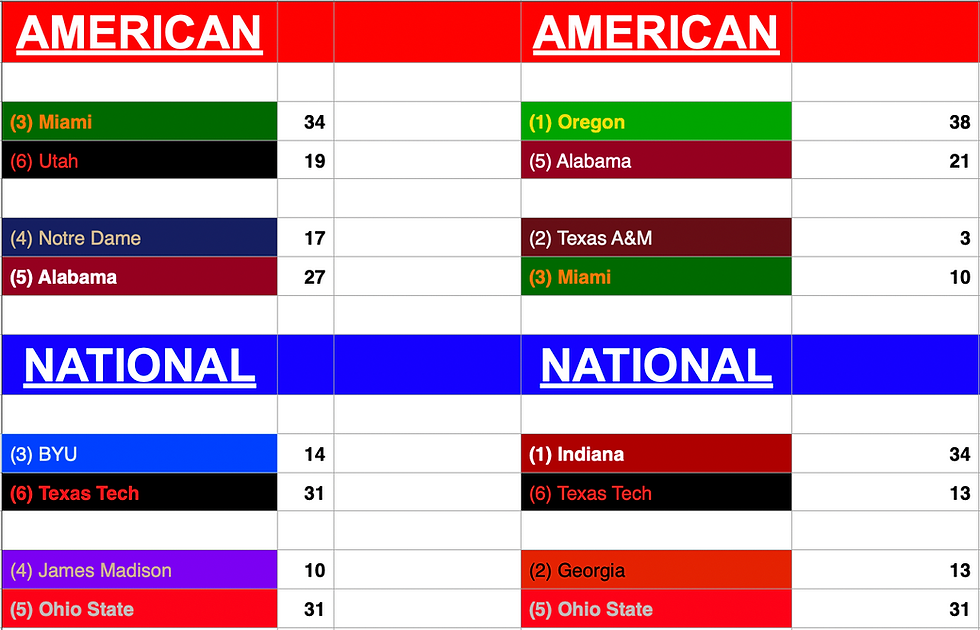
For the most part, the first two rounds of the Super League playoffs were low on entertainment value, apart from 3 of the 4 lower seeds winning on the road. James Madison gives it a valiant effort at home in Harrisonburg, but Ohio State's defense proves dominant, and in the other National Conference game, Texas Tech beats BYU just as they did twice in the real-life season, albeit by a slightly smaller margin on the road in Provo. The lone home team to win, Miami, does it with relative ease against Utah, but the other Amercian Conference game gives us the lone true "upset" of the round as Alabama knocks off Notre Dame, coming from behind in South Bend much as they did at Oklahoma in the real-life playoff.
In the conference semifinals, both 1-seeds win big, Oregon and Indiana dispatching Alabama and Texas Tech respectively with virtually the same amount of ease at home. It was the 2-seeds in each league that fell victim in this round; no reason to change a game that actually took place, so in this reality, Miami once again knocks off Texas A&M on a blustery day in College Station. And in yet another timeline, Ohio State gets the better of Georgia-- this time on the road in Athens, the Buckeyes jump out to a huge early lead, and are able to ride out a big win in a hostile environment.
Semifinals and Final (winning teams are bolded)

In the conference championships, we get yet another universe (4 for 4!) in which Indiana and Ohio State meet up for a rematch of their Big Ten championship. Out all 4 of the hypothetical rematches, this is the most straightforward of any of them: much as they did in real life against Oregon, Indiana explodes out of the gates in Atlanta, and rides a big halftime advantage to victory in the Peach Bowl. In the American championship at the Fiesta Bowl, top seeds Oregon and underdogs Miami play a back-and-forth thriller with Mario Cristobal getting the best of his former team thanks to his new team's late defensive stand.
If you're keeping track at home: this would, yes, once again set up the Hurricanes meeting Indiana on South Beach, making this the second alternative playoff timeline this year to yield the same exact championship matchup we got in real life. Once again, no need to change reality in terms of how this hypothetical game played out: Indiana wins the Super League Final over Miami in a thriller, 27-21.
BONUS ALTERNATE REALITY: POSTSEASON POLLS AND 2026 BOWLS
Brief explainer of the format
The final polls of the 2025 season are frozen in time, and used as the 2026 preseason polls
i.e., Indiana and Miami automatically kick off next season as the Top 2, Alabama and Notre Dame automatically at numbers 9 and 10, etc., etc.
Major bowl games from "Bowl season" is moved to the start of the college football season
15 bowl games to kick off the year, featuring:
The entirety of the Top 25
Every conference champion
For any remaining slots that haven't been filled by the above, the bowl game(s) in question will pick the best team (based on the 2025 season) from a conference with a traditional tie-in
Just as is the case with the current system, bowl games decided by conference tie-ins and geographical sense
How it all will go down
Yes, this is yet another wild proposal for College Football in yet another attempt to launch my campaign for College Football Commissioner. But, much like some of the playoff formats I promote, I really do think this idea is 1. Not as crazy as it sounds, and 2. a genuine boon to the ever-changing sport.
The first half of this is the polls; we can all agree preseason polls are essentially meaningless, right? They're pure conjecture and serve no real purpose other than to create a sort of seeding system out of the gate. Fortunately in the era of the playoff (especially of the expanded playoff), their impact has been somewhat reduced, but back in the days of the BCS, when you basically kept your place in the polls as long as you didn't lose, teams could get left out of playing for a championship simply because a bunch of journalists or football coaches decided before the season that they weren't going to be as good as they ended up being. Why not shift that to a preseason polling system that's based on something real: the team's finish to last season? If you win the title, you're the # 1 team the following year, simple as that. If you finished in the Top 10, you start next year in the Top 10. Let's reward the teams that proved it on the field last year, and let the teams that might be thought to be better the following season prove it in that season.
The second half is arguably more radical, but also a little less out of left-field: moving the bowl season to the beginning of the season is a proposal that has gotten real steam amongst online college football fans, and even has found some support amongst coaches and amongst talking heads on TV. After all, once the playoff began and especially once opt-outs became much more mainstream in the last decade, bowls undoubtedly began losing a lot of their luster. Plus, think of how many kickoff games at neutral sites we see now! Atlanta. Charlotte. Dallas. L.A. Las Vegas. Aren't these essentially doing the same thing bowl games are doing, just without the celebration (and trophy) involved with being in a bowl?
The way I say it, this two-part proposal accomplishes the following:
It maintains the special and unique bowl tradition, without a huge amount of opt-outs
It satisfies broadcasters’ and fans' shared desire for big games to start off the season
It's an additional reward for many teams whose good-to-great season might have been muted by the lack of playoff success (or even participation)
It helps keep player and coach investment all the way to the end of the season, knowing the following season will be effective (likely making the transfer portal and coach carousel a lot less chaotic)
So, based on the criteria I've laid out above, here is how the start of the 2026 season would look:


I mean, come on. Even the most ardent traditionalists among you have to admit this looks kind of awesome, right? A college football season that begins with a bowl season like this, and a 24-team playoff that allows for every conference champion and quality team? Admit it. You'd gobble it all up.
There you have it: different playoff formats this year may or may not have yielded different champions, but compared to years past, the chance of variety feels much greater. And even if Indiana had won in every universe-- which this simulation doesn't necessarily think would have been the case! --the different styles almost certainly would have resulted in different championship games, and offer the possibility for a much more entertaining and satisfying route there. How much longer will this 12-team field last? Are even more major changes coming soon?
Comments